

In the third quarter of 2013 the small and medium enterprises show a positive image about their current business situation. All of the indicators referring to the current situation showed an increase compared to the previous period. In contrast, the expectations for the future indicate a negative outlook, as all of the forecasting indicators fell. These opposing effects resulted a decrease of the SME Business Climate Index. The Uncertainty Index also decreased comparing to the previous period, what means that the diversity of opinions among SMEs has reduced the on the previous quarter.
On the following link an English summary of the paper can be downloaded.
Read more >>>
In 2012, there was a greater economic downturn than expected in Hungary (-1.8%) as the gap between the actual level of production and its level before the crisis got deeper again. The biggest drop occurred in the last quarter of 2012 (-2.5% compared to the same period last year, according to seasonally and calendar-adjusted, balanced data). However, according to the currently available data of GDP in this year (-0.5%, 0.1%) reports that the recession is not deepening further and the Hungarian economy is leaving its lowest point. According to the results of the business climate research of the IEER the a further strengthening of the positive changes can be expected. The IEER Business Climate Index rose to +23 points in October from +14 points in April.
On the following link the Hungarian paper with an English summary can be downloaded.
Read more >>>
Within the framework of the SME Outlook research, since January 2005 the HCCI Institute for Economic and Enterprise Research (IEER) conducts a quarterly analysis of the situation of small and medium sized enterprises, their short-term prospects, as well as the economic and institutional factors affecting this business group. For this project a total of 300 companies operating within the fields of manufacturing, construction and services is surveyed and the data is analyzed in every quarter. The structure of the sample remains the same from quarter to quarter, with the companies surveyed representing the economic performance and sector distribution of small and medium sized enterprises in Hungary.
Indicators pertaining to the current situation of small and medium sized enterprises were mixed and somewhat negative for the second quarter of 2013. Compared to the previous quarter, only the business situation indicator increased for all current situation indicators. By contrast, future expectations indicate optimism, because apart from stagnation in employment numbers, all other forward-looking indicators increased; this was particularly evident in the sharp increase in anticipated investment activity.
On the following link an English summary of the paper can be downloaded.
Read more >>>
According to preliminary statistics data released by the Central Statistics Office (CSO, or KSH in Hungarian), seasonally and calendar-adjusted gross domestic product fell by 0.3% in the first quarter of 2013 compared to the same period last year, but compared to the previous quarter a 0.7% increase was observed.
Indicators pertaining to the current situation of small and medium-sized enterprises (SMEs) showed a consistent picture for the first quarter of 2013. Compared to the previous quarter, current situation indicators had all increased slightly. Expectations for the next year don't reflect this optimism, however; particularly evident is the sharp decline in expected investment activity.
The overall effect of these contradictory results has led the SME Business Climate Index to idle after experiencing a strong rise during the previous survey; although the value is still rising, it's at a much slower rate than in the previous quarter. The Uncertainty Index declined somewhat; in other words, a decline can be seen in the diversity of opinions of SME assessments toward their current and expected business situations.
The share of small and medium-sized enterprises with bank loans has been steadily declining since October 2011; its current value is at 62%. In terms of loan type, it can be stated that firms are still mostly indebted in HUF. The proportion of business loans in Euros and Swiss francs has declined significantly since April 2012, and currently represents 25% and 1.1% respectively of all SME loans.
During the past half year 17% of the businesses surveyed inquired at a bank about the possibility of borrowing money, which is a rate two percentage points lower than in April 2012.
On the following link an English summary of the paper can be downloaded.
Read more >>>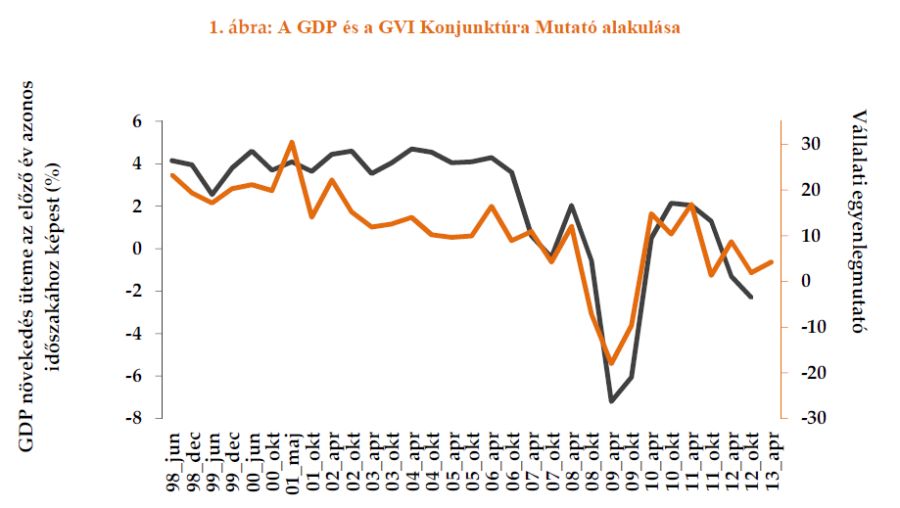
April 2013 was the thirty-first occasion of the HCCI Institute for Economic and Enterprise Research (IEER) business climate survey which is based on the cumulative response of more than 14,000 companies and conducted in April and October of each year, with the participation of regional chambers. It is the largest and most extensive business climate survey of its kind in Hungary. The research is part of the 14 million enterprise-wide Eurochambres survey of the European economy. In April this year 3,500 firms filled out our questionnaire -- our study is based on these responses.
The IEER business climate index rose 2.3 points from the October level of 1.9 points, and now stands at 4.2 points. This is still characterized as a weak positive result, which is underscored when the data is compared to the level in April of each year: this is the second lowest level since the start of the study (1998). The value of the uncertainty index is at the 43.6-point level. This suggests that within the business community there is still no clear or unanimous opinion of current trends. In addition, together with data available on the current performance of the Hungarian economy and the IEER business climate data, our attention is drawn to the slight decrease in uncertainty surrounding the current year
On the following link an English summary of the paper can be downloaded.
Read more >>>
The results of the January 2013 IEER SME Outlook business climate survey reveal more favourable economic conditions compared to the previous quarter. The SME Outlook Business Climate Index (BCI) increased from -6.6 to 5.4 percentage points, which is the highest value since July 2011. Regarding the Uncertainty Index stagnation can be observed, which means that there is no change in the perception of the SMEs about their current and expected business situation. The Uncertainty Index is at a current level of 41 percentage points, which is almost the same as the value measured in the preceding quarter (it was 42 percentage points in October 2013).
Read more >>>
The following analysis was prepared within the framework of a joint quarterly research project entitled "SME Perspectives", involving the HCCI Institute for Economic and Enterprise Research (IEER) and Volksbank. For the survey a sample of about 300 small and medium enterprises with similar structures and elements were used.
In our analysis we try to find out to what extent does the perception of corruption affect satisfaction with the institutional environment, and what kind of corruption experiences have the greatest effect on this satisfaction. First, we present the company managers' perceptual changes towards corruption and also how their satisfaction with the institutional environment has evolved during the period from 2005 to 2010. Then, we search the variables that affect the development of this satisfaction. Our analysis shows that the higher the degree of corruption, the more negatively managers regard the institutional environment. Among the different corruption experiences cited, what makes managers significantly dissatisfied is, firstly, when they feel that their company has to pay bribes in order to get anywhere economically and, secondly, whether they consider corruption to be a major problem or not. Research of corruption is partly based on perception. Our analysis shows that subjective opinions are still relevant in the sense that much depends on personal experiences with corruption.
On the following link an English summary of the paper can be downloaded.
Read more >>>
January 2013 was the thirteenth occasion of the quarterly business climate survey of the Institute for Economic and Enterprise Research (IEER). For this study, a total of 400 companies are followed every quarter that are representative of the economic performance and sector distribution of firms operating in Hungary. A survey of changes in ten different business climate indicators related to the business situation and prospects of firms are analyzed and summarized in the format of the IEER Business Climate Index.
The latest results reveal a more favourable economic condition compared to the previous quarter. The IEER quarterly Business Climate Index increased significantly; following a low point from the previous quarter, it jumped to a level last measured in the second quarter of 2011. For both the current business situation of enterprises and short-term expectations positive changes uniformly took place in late 2012: in the following half-year all indicators had risen sharply. In terms of expected changes in staff numbers, optimism hitherto never before seen in the history of the survey was reported. After high growth in indicators for expected investment activity, those representing intensification of investments entered positive territory. The value for the uncertainty index compared to the previous quarter slightly decreased, indicating a decrease in the diversity of opinions on views toward the current and expected business situation of enterprises
On the following link an English summary of the paper can be downloaded.
Read more >>>
Autumn 2012 marked the seventh collaboration between the Hungarian Labour Inspectorate and the Institute for Economic and Enterprise Research (IEER) for an empirical study into the short-term forecasts of the economic prospects of the private sector and the labour market decisions of firms. In the latest survey into short-term labour market projections, 6,782 company managers were interviewed about current and future workforce prospects.
The results showed that a slightly positive intention to hire more workers can be detected in the expectations of the Hungarian private sector for the coming year. While in 2012 the number of companies that increased their workforce was 10 percentage points higher than those that decreased their employee numbers, in 2013 the corresponding figure was 14 percent. Accordingly, more companies are expected to hire next year than was the case for this year.
In 2013, the likely scenario is of 0.2 percent decrease in the number of employees in the private sector. A pessimistic scenario sees a 0.8 percent decline while an optimistic scenario sees a 1 percent increase in the number of employees in the private sector. The likely scenario is that the number of industrial employees may grow by 0.5 percent. By contrast, all other economic sectors are likely to fall, especially agriculture, where a 1.8 percent decline is expected. It is important to emphasize that the agricultural sector is also expected to decrease under the optimistic scenario as well.
On the following link an English summary of the paper can be downloaded.
Read more >>>
IEER conducted a survey – between 3 and 7 September 2007 – among enterprises about their opinions on the legal settlement options between enterprises and on the working processes of Hungarian tribunals. We analysed the answers – sent back by post, e-mail, fax or online format – of 321 enterprises. In addition, we used telephone queries with legal representatives of 50 large companies. On this research, IEER worked together with the Supreme Court of Hungary and the Hungarian Chamber of Commerce and Industry.
Read more >>>