

Within the framework of the SME Outlook research, since January 2005 the HCCI Institute for Economic and Enterprise Research (IEER) conducts a quarterly analysis of the situation of small and medium sized enterprises, their short-term prospects, as well as the economic and institutional factors affecting this business group. For this project a total of 300 companies operating within the fields of manufacturing, construction and services is surveyed and the data is analyzed in every quarter. The structure of the sample remains the same from quarter to quarter, with the companies surveyed representing the economic performance and sector distribution of small and medium sized enterprises in Hungary.
Indicators pertaining to the current situation of small and medium sized enterprises were mixed and somewhat negative for the second quarter of 2013. Compared to the previous quarter, only the business situation indicator increased for all current situation indicators. By contrast, future expectations indicate optimism, because apart from stagnation in employment numbers, all other forward-looking indicators increased; this was particularly evident in the sharp increase in anticipated investment activity.
On the following link an English summary of the paper can be downloaded.
Read more >>>
According to preliminary statistics data released by the Central Statistics Office (CSO, or KSH in Hungarian), seasonally and calendar-adjusted gross domestic product fell by 0.3% in the first quarter of 2013 compared to the same period last year, but compared to the previous quarter a 0.7% increase was observed.
Indicators pertaining to the current situation of small and medium-sized enterprises (SMEs) showed a consistent picture for the first quarter of 2013. Compared to the previous quarter, current situation indicators had all increased slightly. Expectations for the next year don't reflect this optimism, however; particularly evident is the sharp decline in expected investment activity.
The overall effect of these contradictory results has led the SME Business Climate Index to idle after experiencing a strong rise during the previous survey; although the value is still rising, it's at a much slower rate than in the previous quarter. The Uncertainty Index declined somewhat; in other words, a decline can be seen in the diversity of opinions of SME assessments toward their current and expected business situations.
The share of small and medium-sized enterprises with bank loans has been steadily declining since October 2011; its current value is at 62%. In terms of loan type, it can be stated that firms are still mostly indebted in HUF. The proportion of business loans in Euros and Swiss francs has declined significantly since April 2012, and currently represents 25% and 1.1% respectively of all SME loans.
During the past half year 17% of the businesses surveyed inquired at a bank about the possibility of borrowing money, which is a rate two percentage points lower than in April 2012.
On the following link an English summary of the paper can be downloaded.
Read more >>>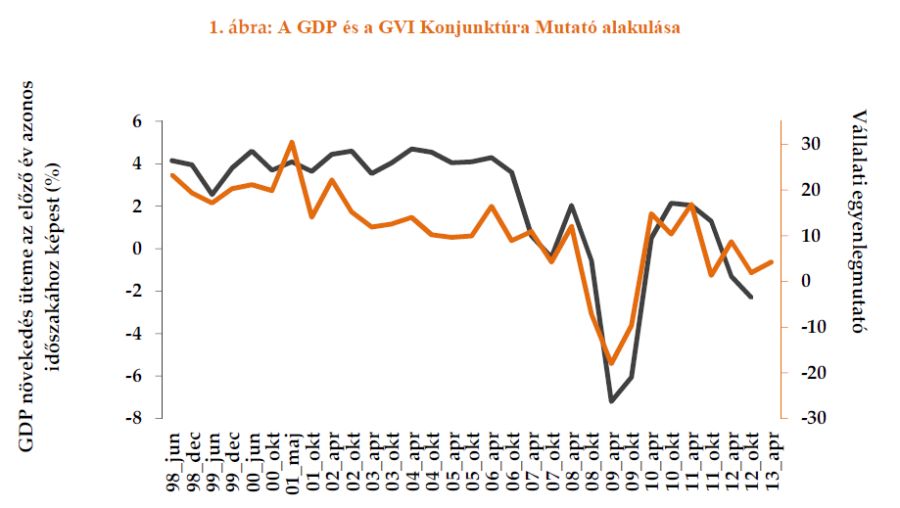
April 2013 was the thirty-first occasion of the HCCI Institute for Economic and Enterprise Research (IEER) business climate survey which is based on the cumulative response of more than 14,000 companies and conducted in April and October of each year, with the participation of regional chambers. It is the largest and most extensive business climate survey of its kind in Hungary. The research is part of the 14 million enterprise-wide Eurochambres survey of the European economy. In April this year 3,500 firms filled out our questionnaire -- our study is based on these responses.
The IEER business climate index rose 2.3 points from the October level of 1.9 points, and now stands at 4.2 points. This is still characterized as a weak positive result, which is underscored when the data is compared to the level in April of each year: this is the second lowest level since the start of the study (1998). The value of the uncertainty index is at the 43.6-point level. This suggests that within the business community there is still no clear or unanimous opinion of current trends. In addition, together with data available on the current performance of the Hungarian economy and the IEER business climate data, our attention is drawn to the slight decrease in uncertainty surrounding the current year
On the following link an English summary of the paper can be downloaded.
Read more >>>
The results of the January 2013 IEER SME Outlook business climate survey reveal more favourable economic conditions compared to the previous quarter. The SME Outlook Business Climate Index (BCI) increased from -6.6 to 5.4 percentage points, which is the highest value since July 2011. Regarding the Uncertainty Index stagnation can be observed, which means that there is no change in the perception of the SMEs about their current and expected business situation. The Uncertainty Index is at a current level of 41 percentage points, which is almost the same as the value measured in the preceding quarter (it was 42 percentage points in October 2013).
Read more >>>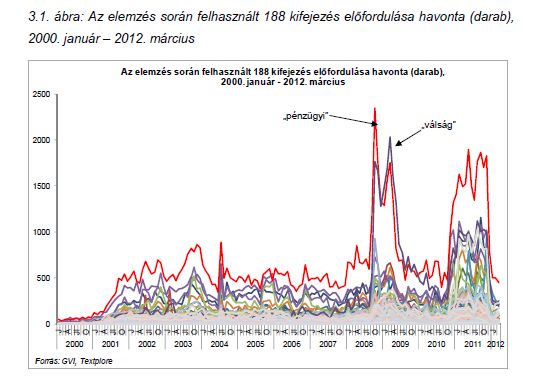
Paper written for the CIRET 2012 conference
The purpose of our study is to find an answer to how real economic processes and their online media representation are connected, that is, whether the economic crisis of 2008-2009 has generally changed the way how Hungarian journalists use economic terms and expressions and whether a learning procedure has begun of a more informed and proficient form of journalism about economic processes.
Based on our analysis we can state that the occurrence of economic terms in connection with economic policy, foreign trade, companies and the crisis contain a break in the trend at the start of the crisis. We can say that because of the crisis the word usage rates within the above word groups increased significantly – except in the case of the foreign trade group, where it fell.
We can also say that knowledge of the occurrence of the economic policy, credit, macroeconomy, financial market, company and crisis word groups provide additional information to estimate industrial sales about a month in advance as compared to if we only use the previous two values of the time series for our estimation.
Read more >>>