
The HCCI Institute for Economic and Enterprise Research (IEER) business climate survey in April 2015 shows that the level of business confidence in Hungary continued to improve compared to that seen in the previous quarter. The IEER Quarterly Business Climate Index has risen from the January level of 16 to 23 points. The current level is the highest since the beginning of the research (January 2005). The current level of the indicator is higher than it was one year earlier. The Uncertainty Index level is at a current level of 38 points, which is three points higher than the level in January; this indicates increase in uncertainty. The current level is the same as the value recorded one year before and higher than the value recorded two years before (in April 2013 it was 37 points). In addition, the value of the Uncertainty Index indicates that the current trend is not uniform within the private sector, and that the recovery will continue to be confined to one part of the economy and will not be felt by all companies.
Read more >>>
According to the results of the IEER Business Climate Survey,further positive changes can be expected in the business climate of the Hungarian companies.The IEER Business Climate Index rose to +42 points in April 2015 from +34 points in October 2014.The increase in the IEER Business Climate Index is due to the fact that all primary indicators are higher than in the previous period.
Read more >>>
Within the framework of the “SME Outlook” research, since January 2005 the HCCI Institute for Economic and Enterprise Research (IEER) conducts a quarterly analysis of the situation of small and medium sized enterprises, their short-term prospects, as well as the economic and institutional factors affecting this business group. For this project a total of 300 companies operating within the fields of manufacturing, construction and services are surveyed and the data is analysed in every quarter. The structure of the sample remains the same from quarter to quarter, with the companies surveyed representing the economic performance and sector distribution of small and medium sized enterprises in Hungary.
On June 1, 2013, the National Bank of Hungary launched the Loans for Growth Program (NHP), albeit the details of the program had been known several months earlier. For the October 2014 SME Outlook survey the leaders of small and medium-sized enterprises were asked about bank loans and the NHP Program by the IEER.
The results show that 56% of small and medium-sized enterprises have some form of bank loan. The most common type of credit is working capital loan (including bank loans). Companies hold mostly forint-denominated loans.
Euro-based loan is the most common foreign currency loan and mainly used by export-oriented companies, companies in the manufacturing sector and medium-sized firms.
Every fifth company among SMEs have applied for loan under the Loans for Growth Program (NHP). More than half of the companies were interested in working capital loans. Every second company applied for a loan up to 50 million forints. The overall opinion of SMEs is that there are no major changes in the terms of access to loans during the period 2013 and 2014.
Read more >>>
Results of the IEER Quarterly Business Climate Survey January 2015
The 2015 IEER Quarterly Business Climate Survey showed that the level of business confidence in Hungary significantly improved compared to the previous quarter. The IEER Quarterly Business Climate indicator rose from 10 points to 19 points. This value is much higher than the one measured in last year in January (8 points). The value of Uncertainty index stands at a 35-point level, which conforms to the value in October. This result shows a stagnation in the level of uncertainty. The 35-point level is higher than the value of the index last year (it stood at 32 points in January 2014). The value of the uncertainty indicator suggests that the current tendency is not universal and that it only concerns a part of the business community.
Read more >>>
Results of the IEER SME Outlook Survey January 2015
The HCCI Institute for Economic and Enterprise Research (IEER) SME Outlook business climate survey in January 2015 shows that after the decline observed in the previous quarter the level of business confidence improved again. The Business Climate Index rose to 16 points from the 9 points measured in October. The index is also higher than it was in last January (9 points). The Uncertainty Index is at 35 points level, which is one point lower than its value in October, so the uncertainty seems to stagnate. The 35 points level is slightly higher than the level measured last year (33 points in January 2014), but lower than the level measured two years ago (41 points in January, 2013). The value of the Uncertainty Index suggests that the current tendency is not universal and that it only concerns a part of the business community, others do not perceive it yet.
Read more >>>
The wage compensation policy helped to offset the negative effect on employment of expected wage increases. The IEER study presents the effects on employment due to the legislative changes of 2012 using data from the National Labour Centre’s Wage Survey and the Hungarian Labor Market Forecast.
Read more >>>
Results of the IEER SME Outlook Survey October 2014
The HCCI Institute for Economic and Enterprise Research (IEER) SME Outlook business climate survey in October 2014 shows that the level of business confidence declined significantly compared to the previous quarter. The Business Climate Index declined to 9 points from the 18 points measured in July. This severed the improving trend observed since the beginning of 2014. However, it is important to note that the index is still significantly higher than it was last year in the same period (2 points). The Uncertainty Index is at 36 points level, which is one point lower than its value in July, so the uncertainty seems to stagnate after the increase in the beginning of the year. The 36 points level is slightly higher than the level measured last year (31 points in October 2013), but lower than the level measured two years ago (44 points in October, 2012). This suggests that the deterioration in business expectations is not universal and that it only concerns a part of the business community.
Read more >>>
The latest GVI study examined the predictive ability of the Purchasing Managers Index. PMI forecasts are more accurate in forecasting a growth in industrial production volume as opposed to a decline. However, upon examining the extent of these changes, a significant correlation can be seen in the changes to the PMI and changes in industrial production three months later.
Read more >>>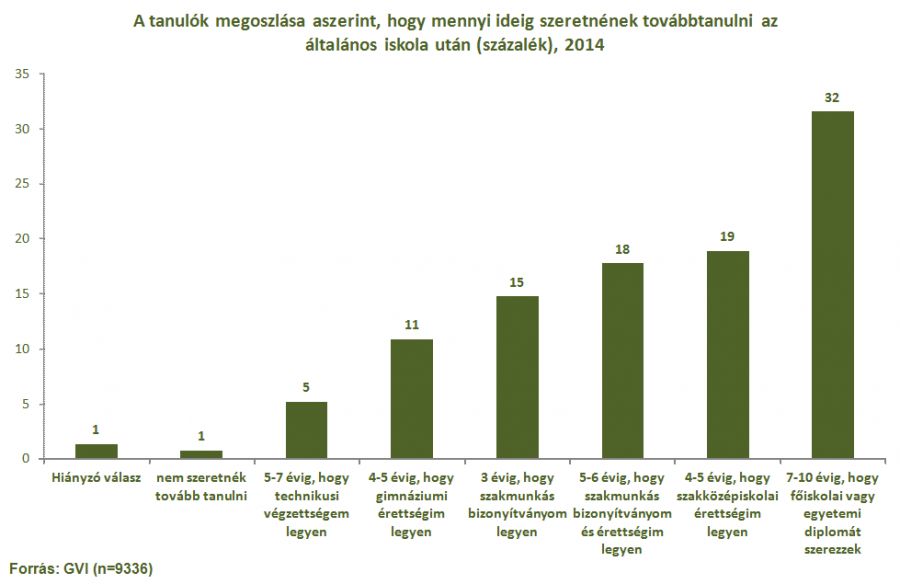
The study examined pre-career, seventh-grade primary school children's interest in further education and career choices. The results are based on the results of the Hungarian Chamber of Commerce and Industry (HCCI) national career guidance study.
Two major groups stood out among seventh grade students: white-collar and blue-collar. The former are more independent, more diligent in learning, and more skilled at intellectual tasks and solving puzzles, but are less talented of practical tasks.This group tends to strive for attainment of higher education, even to obtain a degree and a white-collar profession. Children from the other group are interested in home improvement, repair, and the world of machines, and are less receptive to learning, are more inclined to solve school tasks in groups, and are regarded as less independent. The latter group of young people takes on vocational careers.
Read more >>>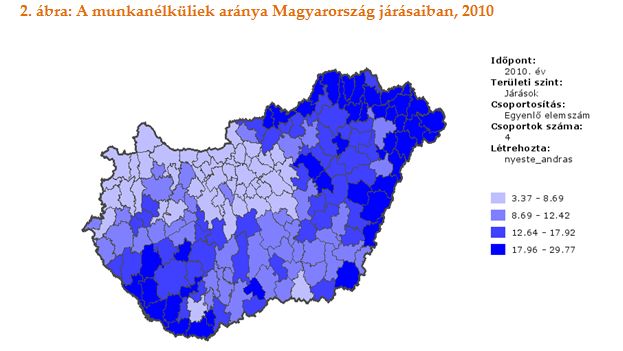
Social and economic developments after the regime change in 1989 have completely transformed our country. In many ways, Hungary was divided into two parts. The advanced, more developed area is increasingly linked to the more developed parts of the EU in all aspects and is an economically and socially emerging area, comprising of the capital city and its environs as well as the north-western part of the country. By contrast, all other parts of the country are increasingly separated from this developed region, and thus also the European average. To further awareness of this situation the HCCI IEER prepared the social and economic profiles of Hungary's regions in 2013 in which the development path of individual regions was clearly shown. In this analysis, based on the latest available data (2007-2012), the differences in the state of development of the 198 Hungarian statistical districts were examined. We present maps showing development on a statistical district scale. The analysis focuses on the regional differences of certain processes and phenomena, and provides an answer to the question of which are the most developed and most underdeveloped regions of our country.
Read more >>>