
- Research fields
- Further Research Areas
- Research year
- Related documents

Our survey in the SME Outlook – fourteenth in a row and conducted during the last week of April 2008 – focused not only on the business situation of SMEs, but also on their response to the minimal wage increase and to the rise in price of energy.
Read more >>>
This research program aims helping the regional development and training committees (RFKB – in Hungarian) in order to establish a quota of the maximum number of different vocational trainings. The research is based on the available statistics on vocational training supplemented by IEER's own large-sample empiric survey from 2008 and it evaluates the expected labour demand for vocational school graduates and compares the results to the expected number of recent graduates in 2012.
Read more >>>
The IEER Business Climate Index stays at 12% (compared to 4.2 % from last year) that shows clear improvement. This change in the short-run ended a decreasing tendency continuous from April 2002 but it is not sure yet whether it will bring alteration to the long-term processes as well. One warning sign might be that the value of IEER Uncertainty Index augmented again (0.49), reaching its peak for the 1998-2008 period.
Read more >>>
Our survey in the SME Outlook – thirteenth in a row and conducted between 24 and 29 January 2008 – focused not only on the business situation of SMEs, but also on their response to government actions towards stabilization with special attention to the spread of chain indebtedness.
Read more >>>
The Institute for Economic and Enterprise Research - in cooperation with Volksbank Hungary Private Ltd. - carried out a public opinion survey questioning 1000 individuals representing the adult population of Hungary by age, gender and type of settlement. Our aim was to analyse people's awareness on the pension system, their earning capacity and saving decisions with a special view on old-age provisions.
Read more >>>
Institute for Economic and Enterprise Research in collaboration with the Ministry of Social Affairs and Labour conducted a research on the expected demand of labour and short-term business expectations of 7247 enterprises.
Read more >>>
Our survey in the SME Outlook – twelfth in a row and conducted between 24 October and 9 November 2007 – focused not only on the business situation of SMEs, but also on their opinions about the economic and political environment.
Read more >>>
Suppliers of large retail chains and daily consumer goods operating in the domestic market
We examined in our research relations and operating mechanisms of the suppliers of large retail chains and daily consumer goods operating in the domestic market using qualitative and quantitative approach. In our survey conducted in the first half of 2007 we contacted managers of supplying firms with interviews (15 of them) and with a structured questionnaire (392 firms). Due to the sensitive nature of the research we experienced a high rate of refusal, yet the statistical reviews performed corroborate that this fact did not distort research outcomes.
Global trends indicate that there is increased concentration underway in the retail industry, in the result of which large-scale retail chains play a so-called „gate-keeper” function in accessing the consumer, thus suppliers increasingly depend on them.
Research outcomes have corroborated that the waybuyer powermanifests itself, including the abuse of it, is well known and tangible in the Hungarian market also. The more powerful a retail chain is in terms of its size and the development of its organisation and tools, the more it avails of the potentials of these tools. Our research result suggests that it is not so much the firms that are weaker and more vulnerable in terms of their size and revenue that are affected to a greater extent, but rather the more powerful and dynamic firms the fundamental interest of which is to access an increasingly broader consumer pool and which, by the same token, have a greater potential to contribute to economic development.
It can also be established from the research outcomes that the impact of commercial chains on suppliers is contradictory: their prevalent power supremacy in their business relations and the consequential uncertainty and unpredictability that evolve in such business relations may result in market distortions. On the flip-side, however, a motivating impact of chains can also be ascertained manifesting itself in increasing innovation and product development on the supplier side.
Read more >>>
The aim of the research is to give a concise review of the situation ofvocational training, and depict thechanges in the structure of vocations and in the content of vocational trainings from the viewpoint of economic growth. Based onin-depth interviews with professionals, we collected the most important changes and actual characteristics of 16 different vocations.
Read more >>>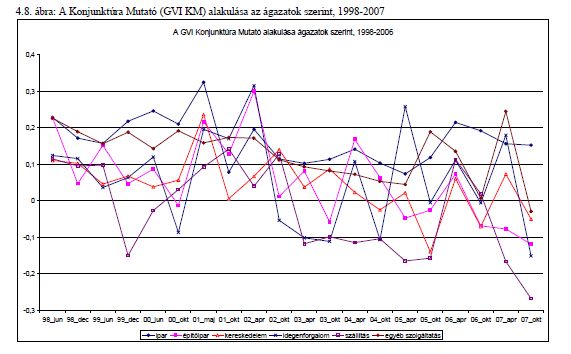
Even though expectations are somewhat less cloudy than half a year ago, firms with pessimistic expectations still scarcely outweigh those with positive prospects. Regarding the longtime trough in 2007's economic growth, prospects might be insufficient for a perceptible upswing in 2008. Business confidence is less favorable in the services sector compared to manufacturing companies. It seems that building industry couldn't overcome the difficulties of the sectoral downturn in 2006. According to the responses businesses' total turnover remained unchanged in 2007 characterized by the contrast of sluggish domestic and vivid external demand. Same is true for expectations, which means that even the expected dynamic growth in exports could fail to outweigh negative effects of weak national sales. Balance figure for domestic sales decreased slightly, favorable balance figure for export sales remained almost unchanged. This is an important aspect, since export is still the main force behind economic activity in Hungary. In the services sector assessment of both present and expected turnover is far less favorable than in manufacturing which is true for domestic and export sales as well.
Read more >>>